🏛️ Custody Structures
Choosing between omnibus and segregated custody for AUDD
When custodying AUDD, selecting the right wallet and account structure is just as important as choosing the blockchain where you operate. Custody structures determine how AUDD is stored, how client funds are segregated or pooled, and how easily you can reconcile transactions. They also influence liability, operational efficiency, and cost.
If you are integrating a non-custodial AUDD product (such as the AUDD Mint), you will need to manage where AUDD is minted to and burned from, including the custody model behind those wallets. For businesses custodying client AUDD, selecting the right custody structure should be considered alongside blockchain selection, as blockchain features can significantly impact efficiency, reconciliation, and transaction costs.
🏗️ Custody Models and Structures
Custody models describe the way balances are recorded and managed on a blockchain. They define how transactions are tracked, how wallets hold value, and how client funds can be organised or reconciled. In practice, digital assets follow one of two main approaches - UTXO or Account-Based - each with its own implications for custody structures and operational processes.
- UTXO (Unspent Transaction Output): Used by blockchains like Bitcoin. Each transaction consumes outputs and creates new ones, which requires careful reconciliation of addresses and balances. AUDD is not issued on UTXO blockchains, so this model is noted here for context only.
- Account-Based: Used by blockchains such as Ethereum, Stellar, Solana, and XRP Ledger. Balances are tracked at the account level, and in some cases can support tags or memos for payment routing. For instance:
- Standard account-based assets (Ethereum, Solana): Each wallet has a single on-chain address. Deposits and withdrawals are tied directly to that address.
- Tag/memo-based assets (XRPL, Stellar): A single on-chain address can be shared across multiple users. Each deposit is routed using a tag or memo field to identify the end user.
As for structures, balances can be organised in two primary ways:
- Omnibus: Client deposits are swept into a central wallet (owned by the business), with internal ledgers keeping track of balances.
- Segregated: Each client or business unit has its own wallet for AUDD.
While both approaches can be applied to account-based blockchains, the mechanics vary depending on whether the chain supports standard addresses or tag/memo-based routing.
🧑💼 Custody Structures in Practice
To illustrate how custody structures work in practice, each model below is demonstrated using the example of minting AUDD.
🏷️ Omnibus with Tag/Memo Support
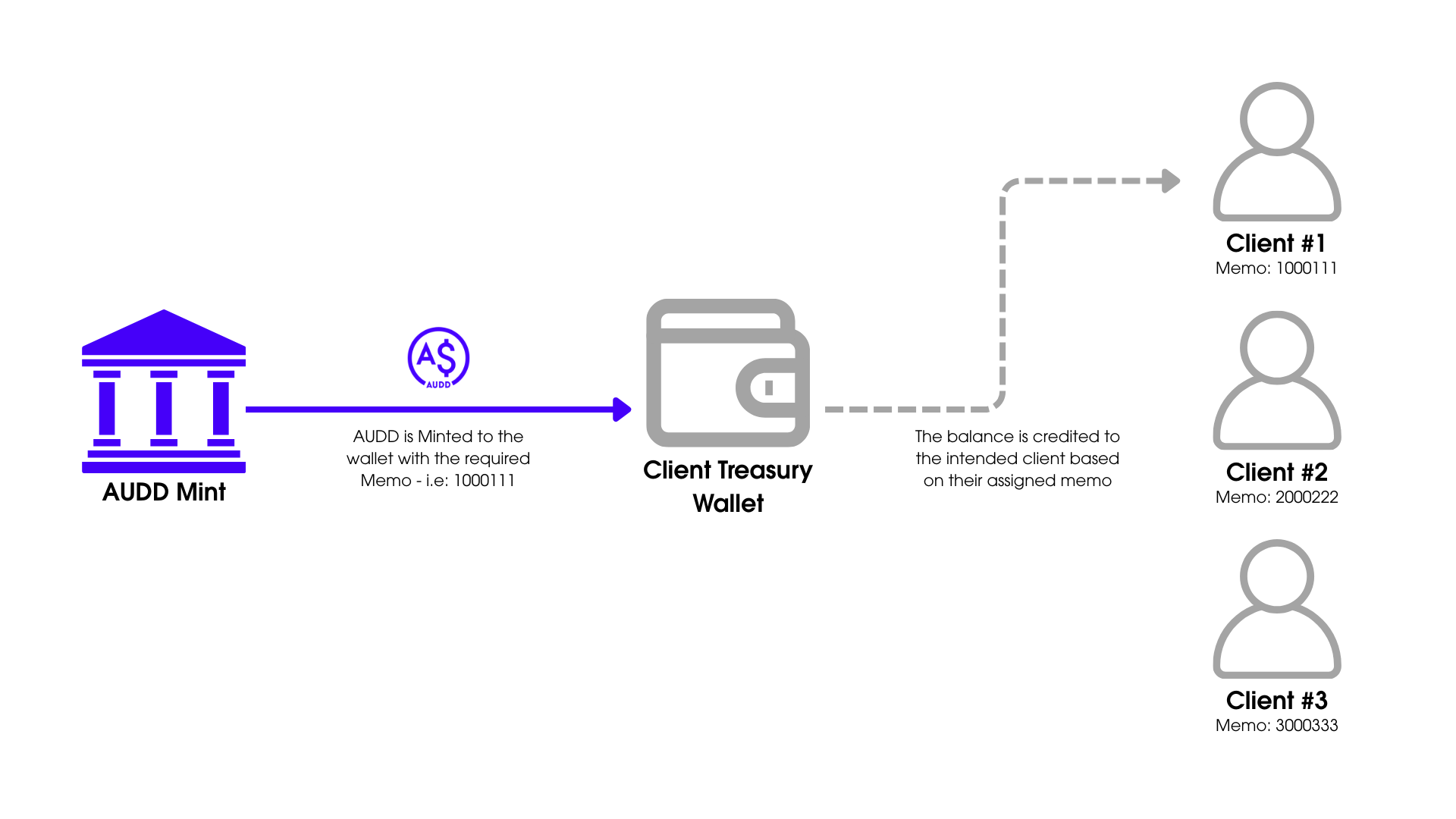
In this model, all minted AUDD is directed into a single wallet on-chain (i.e: the Client Treasury wallet held by the business). Client allocations are distinguished using a tag or memo field rather than separate addresses.
- When AUDD is minted, tokens are deposited into one central address.
- Each client is assigned a unique tag/memo value, which must be included with every transaction.
- The tag/memo on the incoming deposit ensures that the client’s balance is updated correctly within your internal ledger.
The use of tags or memos greatly simplifies account management, since it avoids the need to create and maintain separate wallet addresses for every client - think of this as clients including a deposit reference when they send a bank transfer to help reconcile a transaction against an invoice. Additionally, for blockchains that require Trustlines, this only needs to be established once, which can further reduce the cost of asset lockup.
Don't Miss the Memo!Always include the correct tag or memo when minting or sending AUDD to an omnibus wallet. Missing or incorrect values may require manual intervention to reconcile correctly.
📦 Omnibus without Tag/Memo Support
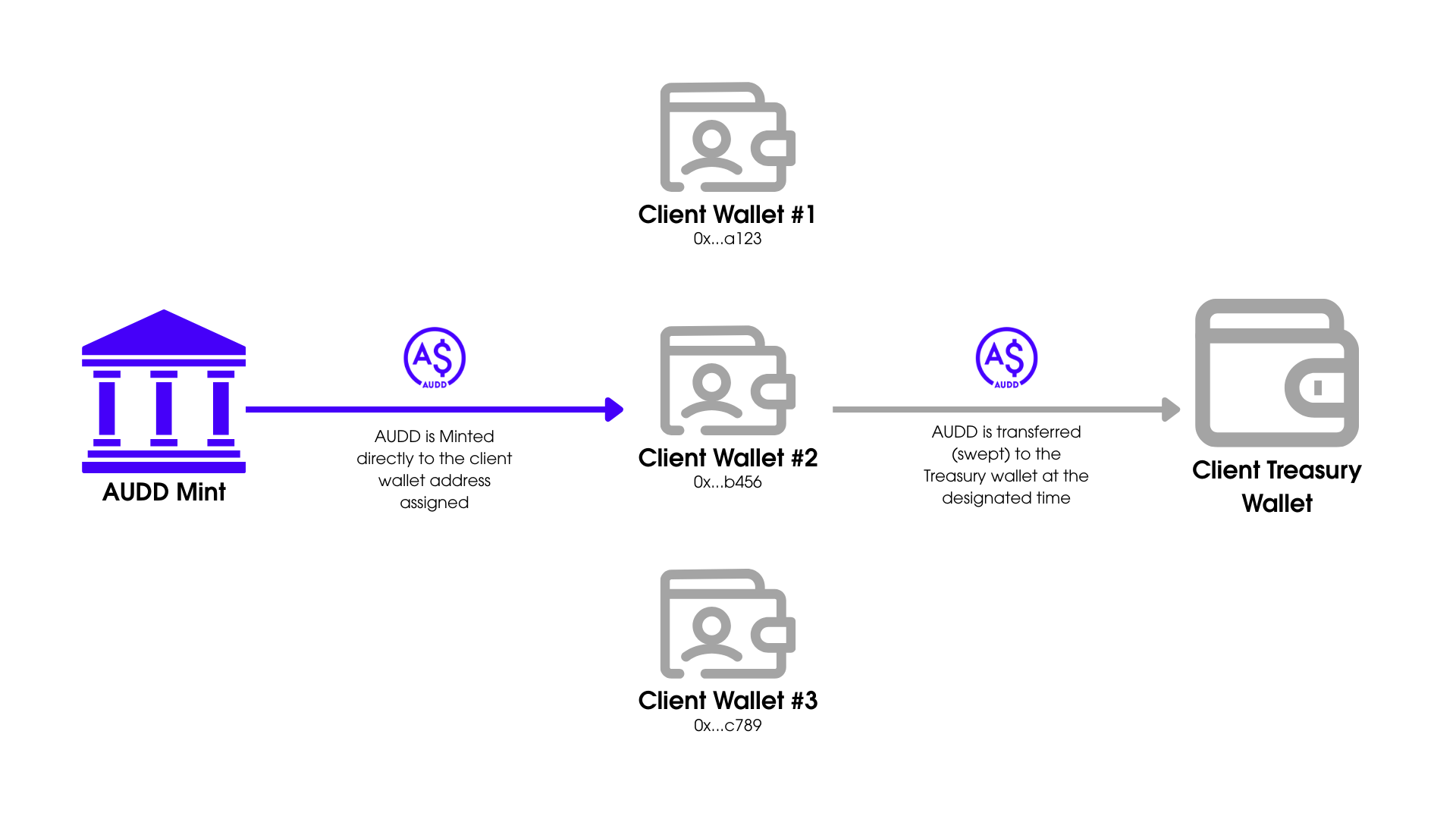
In this model, each client is issued a unique wallet address for deposits. Instead of using tags or memos, ownership is tracked by the wallet itself. Once funds are received, the business sweeps balances from the client wallets into a central treasury (omnibus) wallet for consolidated management.
- Each client is provided with a dedicated deposit wallet.
- When AUDD is minted, tokens are delivered directly to the client’s assigned wallet.
- At regular intervals, AUDD from client wallets are swept into the treasury wallet.
- Client balances are then maintained on your internal ledger, while the treasury wallet acts as the on-chain "vault".
This approach avoids the risk of lost funds due to missing tags or memos, since each client has their own deposit wallet. However, it introduces additional requirements and costs. Native tokens (i.e: Ethereum) must be available in each deposit wallet to cover transaction fees (like gas fees) when sweeping funds into the treasury wallet. If you are taking a self-custody approach, the sweeping process must be carefully designed to minimise costs (i.e: gas price spikes on Ethereum) while keeping balances accurately reconciled between the client wallets, the treasury wallet, and the internal ledger. For those using a custodial service provider, sweeping mechanisms may already be built into the service offering, making this process more efficient.
If you are working with a blockchain that requires Trustlines to be set for an asset, these must be established and maintained for each client wallet in order to hold AUDD. While this only needs to be done once per wallet, it can increase capital lock-up requirements if large numbers of client wallets are in use.
🗂️ Segregated Custody

Segregated custody is similar to the omnibus without tag/memo model, except funds are never swept into a central treasury wallet. Instead, each client or business unit retains a dedicated on-chain wallet, and balances remain isolated at all times.
- Each client is provided with their own unique on-chain wallet.
- When AUDD is minted, tokens are delivered directly into that wallet.
- There is no consolidation into a central treasury wallet - the blockchain itself becomes the source of truth for balances.
This model maximises transparency and segregation, making it easier to demonstrate compliance and simplify audits. Each wallet is directly verifiable on-chain, reducing reliance on internal ledgers for reconciliation. However, it also increases operational overhead: Similarly to the previous model, you must manage a large number of wallet addresses, maintain native token balances in each wallet to cover transaction fees, and handle Trustline setup where required. Unlike the omnibus model, there is no pooling of funds, which means some transaction costs may be saved since balance sweeping is skipped.
Flexible Ownership:In a segregated custody setup, wallets can be managed either by the business (custodying AUDD on behalf of clients) or directly by the client, who takes full ownership of the wallet and private keys. This flexibility allows organisations to design custody arrangements that balance compliance, liability, and client autonomy.
🎯 Choosing a Structure
Selecting the right custody structure is not a one-size-fits-all decision. Each model offers different trade-offs in terms of efficiency, transparency, and cost. The optimal choice will depend on your business use case, regulatory requirements, and blockchain selection.
| Custody Structure | Best For | Key Considerations |
|---|---|---|
| Omnibus with Tags/Memo Support | Institutions managing many clients with high transaction volume. | Efficient to manage, but requires strict handling of tags/memos to avoid lost funds. Trustlines only need to be set up once per wallet. |
| Omnibus without Tags/Memo Support | Businesses that want simplified client onboarding with pooled treasury management. | Requires native tokens for sweeping, careful reconciliation, and trustline management (if applicable). Custodial providers may offer automated sweeping. |
| Segregated Custody | Businesses needing maximum transparency and direct on-chain segregation (regulated entities or clients with strict compliance needs). | Simplifies audits and reduces counterparty risk but increases operational costs and requires careful management of multiple wallets and fee reserves. |
Choosing a custody structure should be done at the same time as choosing a blockchain, since fees, throughput, and account models directly affect the efficiency of each custody approach. For guidance on blockchain selection, see the Choosing a Blockchain guide
Updated about 1 year ago